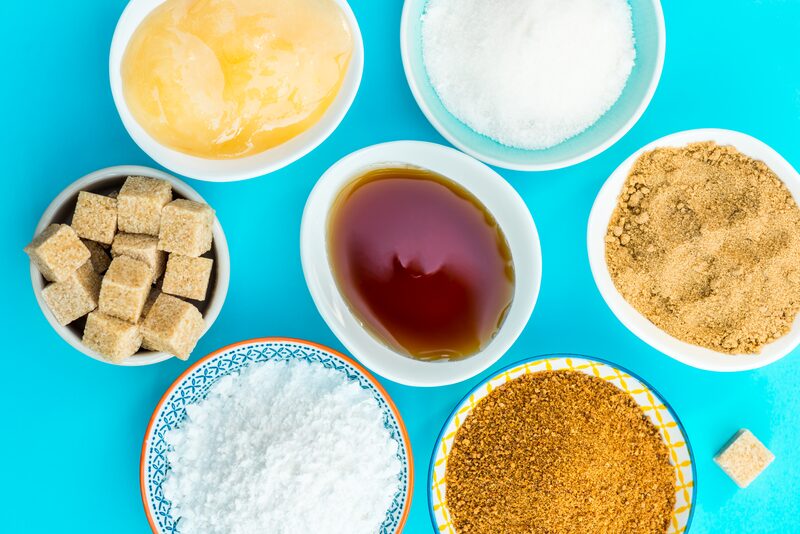
Sugars and Sweeteners
What sugar really does in a bake, how each kind behaves, and how to swap one for another.
Jump to the charts ↓- Sweetness is the smallest part of the job. Sugar holds moisture, controls spread, and browns the crust.
- The kind of sugar controls spread. White sugar spreads the most. Brown sugar spreads less. Powdered sugar spreads the least.
- Cut the sugar and you cut the shelf life. Take out 25 to 30% and the bake is stale a day sooner.
- Liquid sweeteners are not a straight swap. Honey and maple bring water, so some other liquid has to come out.
- Sugar substitutes replace sweetness, not function. Plan to make up the moisture and the browning somewhere else.
Most people think sugar is there to make things sweet. That's the smallest part of what it does. Pull the sugar out of a recipe and you don't get a healthier version of the same thing. You get a different, worse thing.
At my bakery we make everything from full-sugar cookies to brownies with no sugar at all, so I've seen exactly what changes when it moves. This lesson shows you. Start with the swap calculator. Type in the sugar your recipe calls for and pick what you want to use instead.
Sugar behaves the same for everyone. A few of the choices change. Pick yours.
Swap one sweetener for another
Expect a thicker, chewier, moister bake with a little less spread.
What sugar does in a bake
- It holds moisture. Sugar pulls in water and hangs on to it. That keeps a crumb soft, and it slows staling.
- It controls spread. Sugar melts before the batter sets. That window is when a cookie spreads.
- It browns. Sugar is behind both browning reactions, and most of the flavor of a crust.
- It keeps things tender. Sugar ties up water that flour would use to toughen up.
- It holds air. The crystals cut tiny air cells into butter when you cream them together.
- It feeds yeast. A little sugar gets a dough moving.
In a gluten-free bake this matters even more. Wheat has a gluten net to hold on to water. Rice flour, tapioca and potato starch don't. Without sugar binding that water, the crumb is fine on day one and sandy by day two.
Every sugar on one chart
Dry sugars
| Sugar | What it is | What it does | Best in |
|---|---|---|---|
| Granulated white sugar | Pure sucrose in large crystals. | Melts clean. The most spread, and a crisp, snappy edge. | Crisp cookies, cakes, meringue |
| Cane sugar | Granulated sugar, a little less refined. | Bakes the same as white sugar. | Anywhere you would use white sugar |
| Light brown sugar | White sugar with molasses added back. | Holds more water and is a little acidic. Thicker, chewier, moister, less spread. | Chewy cookies, muffins, quick breads |
| Dark brown sugar | The same, with more molasses. | The same effect, stronger. Deeper flavor and color. | Gingerbread, spice cakes, rich cookies |
| Powdered sugar | Sugar ground to dust, with about 3% cornstarch. | The starch soaks up liquid, so the dough barely spreads. Melts in the mouth. | Shortbread, cut-out cookies, frosting |
| Coconut sugar | Dried coconut palm sap. | Caramel flavor. Drier and coarser, so a little less spread and a darker bake. | Cookies, muffins, crumb toppings |
| Raw and turbinado sugar | Large golden crystals. | They don't dissolve easily. Crunch on top, grit inside. | Sprinkled on muffins and scones |
Liquid sweeteners
| Sweetener | What it is | What it does | Best in |
|---|---|---|---|
| Honey | About four fifths sugar, one fifth water. | Holds water harder than sugar. Browns fast. Softer, denser, moister. | Soft cakes, breads, granola |
| Maple syrup | About two thirds sugar, one third water. | Flavor, moisture and color. Thinner than honey. | Muffins, quick breads, glazes |
| Agave | Sweeter than sugar, mostly fructose. | Browns very fast. Keeps things soft. | Soft bars, sauces |
| Molasses | What is left when sugar is refined. Dark and acidic. | Strong flavor and deep color. Reacts with baking soda. | A spoonful for color and chew |
| Corn syrup and brown rice syrup | Glucose syrups. | Stop sugar from crystallizing. Add chew and shine. | Caramel, chewy bars, glazes |
| Barley malt syrup | Sprouted barley. | Malty flavor and strong browning. It is not gluten-free. | Bagels and wheat breads |
Sugar substitutes
| Sweetener | What it is | What it does | Good to know |
|---|---|---|---|
| Allulose | A rare sugar with almost no calories. | The closest match. Holds moisture and browns. | It browns faster than sugar, so watch the bake time. |
| Erythritol | A sugar alcohol. | Sweet, but it does not brown or hold moisture. | Pale, dry and quick to stale, with a cooling taste. |
| Stevia and monk fruit | Very strong sweeteners used in tiny amounts. | Sweetness only. The bulk of the sugar is gone. | Needs a bulking ingredient to work at all. |
| Baking blends | A strong sweetener mixed with a bulking one. | Closer to sugar by volume. | Read the label. They are not all one to one. |
Sugar and spread
If your cookies run into one sheet, or sit in tight domes, look at which sugar you used before you change anything else.
| Sugar | Spread | Why | The cookie you get |
|---|---|---|---|
| Granulated | The most | It melts into a thin liquid before the dough sets. | Wide, thin, crisp |
| Brown | Moderate | The molasses is acidic, so the dough sets sooner, and it holds on to water. | Thicker, chewy, moist |
| Powdered | The least | The cornstarch soaks up the liquid. | Holds its shape, tender |
| Liquid sweeteners | It depends | They add water and brown fast. | Soft, dense, dark |
Spreading too much? Move some white sugar to brown or powdered. Not spreading? Move the other way. My chocolate chip cookies use almost three parts brown sugar to one part cane sugar. The cane sugar gives the crisp edge. The brown sugar keeps the middle soft for days.
Sugar and browning
There are two browning reactions, and they need different things.
| Reaction | What it needs | What it tastes like |
|---|---|---|
| Caramelization | Sugar and heat. It starts around 320°F (160°C). | Nutty, toasty, a little bitter |
| The Maillard reaction | Sugar and protein and heat. It starts at a lower temperature. | Roasted, savory, complex. This is what bread crust tastes like. |
Plain white sugar is slow to join the second one. Brown sugar, honey, maple and molasses jump straight in, which is why they brown harder and faster.
Gluten-free flours are low in protein, so the second reaction runs weak. That's the real reason so many gluten-free bakes come out pale and flat tasting even when they're fully baked.
How to fix a pale bake
- Swap part of the white sugar for brown sugar, honey or maple, or add a spoonful of molasses.
- Brush the top. Egg wash or milk for most bakers. Plant milk with a little maple syrup if you bake vegan. More in egg wash replacements.
- Add protein. A spoonful of milk powder in a wheat dough. A few percent of sorghum, buckwheat, teff or chickpea flour in a gluten-free blend.
- Bake a little hotter for a little less time.
- Check the acid. A batter that's too acidic won't brown. See the pH chart.
How much sugar a bake carries
These are typical ranges, as a share of the flour weight. They aren't rules. They show you how much room a recipe has before it stops behaving like itself.
| Bake | Sugar, as a share of the flour | What that tells you |
|---|---|---|
| Lean bread | 0–5% | Just enough to feed the yeast and color the crust. |
| Soft rolls and sweet dough | 10–20% | Softer crumb, and it keeps longer. |
| Scones and biscuits | 15–25% | Barely sweet. The fat does the work. |
| Muffins and quick breads | 40–70% | Sweet enough to stay moist for days. |
| Cookies | 50–100% | Sugar is a main ingredient. It sets the spread. |
| Cakes | 80–120% | As much sugar as flour, or more. That is what makes cake soft. |
| Brownies | 150% and up | More sugar than flour. That is the fudgy texture and the shiny top. |
How to cut sugar without ruining it
- Go 10% at a time. If the recipe has 200 g, test it at 180 g. Bake it next to the original. That's how we change any recipe at the bakery.
- Expect it to stale sooner. Cut 25 to 30% and you will notice it on day two.
- Put the moisture back. A little more fat, or a binder like psyllium that holds water.
- Bake it a touch less. Less sugar means it dries out faster in the oven.
- Using a substitute? You're changing the recipe, not swapping an ingredient. Start with a blend made for baking, and be realistic about shelf life.
More in what sugar does. For keeping blood sugar steadier when you do eat something sweet, see how I keep my blood sugar in check.
How to swap liquid sweeteners
Honey, maple and agave bring water with them, and they're heavier than sugar by the cup. So you use a bit more by weight and take some other liquid out. These are starting points. Test, then adjust 10% at a time.
| Swap 100 g of white sugar for | Use | Take out of the other liquid | Also |
|---|---|---|---|
| Brown sugar | 100 g | Nothing | Chewier, moister, a little less spread. |
| Coconut sugar | 100 g | Nothing | Darker, with a caramel taste. A little drier. |
| Powdered sugar | 100 g | Nothing | Much less spread. Weigh it. A cup of it is far lighter. |
| Honey | 125 g | 20 g | Lower the oven by 25°F. It browns fast. |
| Maple syrup | 120 g | 25 g | Lower the oven by 25°F. |
| Agave | 110 g | 25 g | Lower the oven by 25°F. It browns the fastest. |
What to buy, and what to spend
If you only keep white sugar, this is the one to add. It fixes spread, pale color and day two dryness, and you can swap it in gram for gram.
Start hereA small clay disc. Soak it in water for 15 minutes, dry it off, and drop it in the brown sugar container. The sugar stays soft for months.
Powdered sugar gets sifted every single time. Unsifted, it leaves grit in a frosting that no amount of mixing takes out.
Keep every sugar airtight. White sugar clumps when it gets damp, and brown sugar turns to rock when it dries out. Not sure which sugar a recipe wants? Ask me below.
What went wrong? Tap your problem
Sugar causes more problems than people think, but it's never the only suspect. For each one, here's the sugar answer and what else to check.
Cookies spread into one sheet
Too much white sugar. It melted before the dough could set.
The fix: Move some of the white sugar to brown or powdered.
- The dough was not chilled.
- A fat that melts early, like coconut oil.
- Too little flour, from measuring by the cup.
Go deeper: Fats and oils · Bake straight from frozen
Cookies won't spread
Too much powdered sugar, or all brown and no white. The cornstarch is soaking up the liquid.
The fix: Move some of it to granulated sugar.
- Too much flour.
- Not enough fat, or a fat that melts late.
- The oven is too hot.
Go deeper: Fats and oils · Oven temperatures
Pale crust
Only white sugar, and not much protein to brown with.
The fix: Add brown sugar, a spoonful of molasses, or brush the top before baking.
- A batter that is too acidic.
- The oven is running cool.
- A gluten-free blend that is all starch.
Go deeper: The baking pH chart · Gluten-free flours
Stale by day two
Not enough sugar to hold the moisture in.
The fix: Bring the sugar back up, or trade some of it for brown sugar, honey or maple.
- Not enough fat.
- It was stored in the fridge.
- It was overbaked.
Go deeper: Make your bakes last longer · Storage and shelf life
Gritty texture
The sugar never dissolved.
The fix: Cream it longer, use a finer sugar, or add the liquid earlier.
- Coarse rice flour.
- Powdered sugar or cocoa that was not sifted.
- A batter that did not rest.
Go deeper: Gluten-free flours · Flour handling
Dark bottom, raw middle
Too much honey, maple or molasses for the oven temperature. They brown before the inside is done.
The fix: Lower the oven by 25°F and bake longer. Use a lighter-colored pan.
- The oven runs hot.
- The rack is too low.
- A dark pan.
Go deeper: Oven temperatures · Internal temperatures
Sticky, tacky top
A lot of honey, maple or brown sugar. They pull water out of the air.
The fix: Trade some of it for white sugar, and store the bake airtight once it's fully cool.
- It was wrapped while still warm.
- A humid kitchen.
- It is a little underbaked.
Go deeper: Storage and shelf life
Sweet but flat tasting
All sweetness and no depth. White sugar alone doesn't bring much flavor.
The fix: Trade some for brown sugar, and make sure there's enough salt.
- Not enough salt.
- No acid in the recipe to brighten it.
- It did not brown enough.
Go deeper: The complete guide to salt · How much vinegar to use
Quick questions
Can I reduce the sugar in a recipe?
Yes, a little at a time. Cut 10%, bake it next to the original, and see what changed. Past 25 to 30% the bake will be drier, paler and stale sooner, because sugar holds moisture and browns the crust.
Can I substitute honey for sugar?
Yes. As a starting point, use 125 g of honey for every 100 g of sugar, take about 20 g out of the other liquid, and lower the oven by 25°F because honey browns fast.
What is the difference between brown and white sugar in cookies?
White sugar gives a wider, thinner, crisper cookie. Brown sugar has molasses in it, which holds water and is slightly acidic, so the cookie is thicker, chewier and moister.
Can I use coconut sugar instead of white sugar?
Yes, gram for gram. The bake will be darker with a caramel flavor, and a little drier with slightly less spread.
Is powdered sugar gluten-free?
Usually. Most powdered sugar is cut with cornstarch, which is gluten-free. Check the label, because some brands use a different starch.
Why are my bakes pale?
Not enough browning. Use some brown sugar, honey or maple, brush the top before baking, and check that the batter is not too acidic. Gluten-free bakes are paler because the flours are low in protein.
Do sugar substitutes work in baking?
They replace sweetness, not function. Allulose is the closest match. Erythritol does not brown or hold moisture, and stevia and monk fruit need a bulking ingredient. Expect a shorter shelf life.
Ten quick ones before you go
Get 7 right and the lesson is done.
Besides sweetness, what does sugar do in a bake?
Which sugar gives the most spread?
What makes brown sugar brown?
Why does powdered sugar hold a cookie in shape?
Your cookies spread into one sheet. What do you change?
Which browning reaction needs protein?
You cut the sugar by 30%. What happens by day two?
You are swapping honey in for sugar. What else changes?
What is the safe way to cut sugar in a recipe?
Which substitute behaves most like sugar?
Ask me about sugar
Trying to cut the sugar, or swap one sweetener for another? Ask here. I read every question, and your answer helps the next baker too.