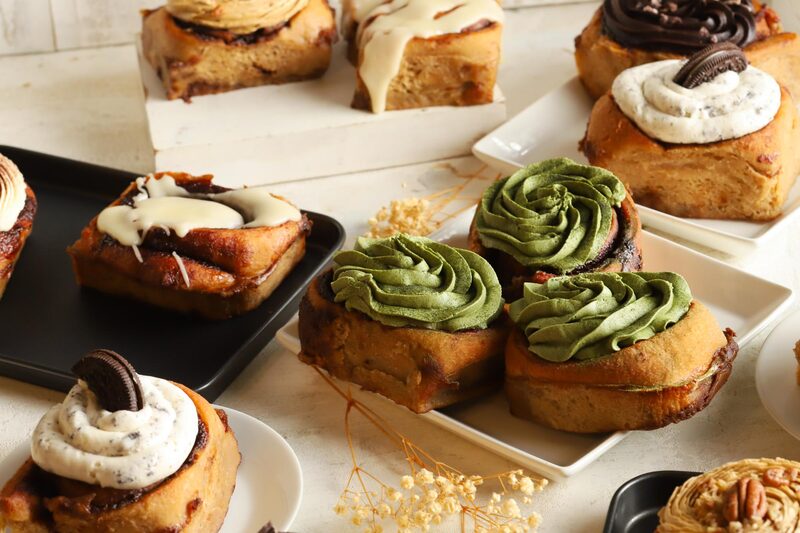
Sourdough and Yeasted Cinnamon Rolls
Gooey, bakery-style cinnamon rolls with three variations.
Skip to recipe ↓Cinnamon rolls are one of the hardest things to get right without gluten. The dough has to be soft enough to roll into a two-foot sheet, yet structured enough to hold a tight spiral through a long proof and a hot oven. This recipe solves that with a psyllium-bound dough and three ways to leaven it: a hybrid method that uses both a gluten-free sourdough starter and yeast, a faster full-yeast version, and a slow full-sourdough version for the deepest flavour.
Watch Out — Pitfalls to Avoid:
- Do not add extra flour if the dough seems sticky — this is normal.
- Whip your filling for at least 90 seconds. If it melts on the dough, it was not whipped enough.
- Be generous with flour on your work surface or the dough will stick.
- Always spread filling from the centre outward to avoid reshaping your rectangle.
- Do not roll too tight — the rolls need room to expand during proofing.
- Do not let rolls over-proof past their peak rise.
- Never eat gluten-free baked goods warm. Always cool completely first.
Sourdough and Yeasted Cinnamon Rolls
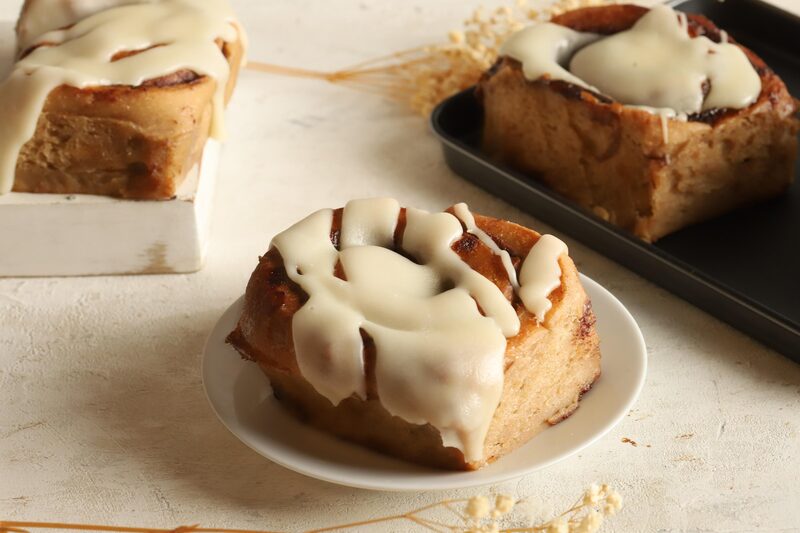
Tools Required:
- Standing mixer with hook attachment
- Mixing bowl with whisk/beater
- Immersion blender
- Kitchen scale
- Spatula
- Large countertop workspace
- Baking pan (greased)
- Cloth or plastic wrap
- Extra flour for dusting
Choose Your Method:
The ingredient amounts below are the hybrid method, which uses both sourdough starter and yeast. To make one of the single-leavening versions, keep everything else the same and apply these adjustments:
Full yeast version (proof time: 1.5 hours): remove the sourdough starter (192g), add 96g water, add 96g rice flour, and increase yeast to 3 tsp.
Full sourdough version (proof time: 6+ hours): remove all yeast, keep 192g sourdough starter, cut the oil in half (57.5g), cut the sugar in half (35g), and add 1 tsp vinegar.
Dry Ingredients:
- 216g Tapioca flour
- 198g Potato starch
- 72g Rice flour
- 108g Oat flour
- 30g Psyllium husk powder
- 8g / 3.25 tsp Xanthan gum
- 14g / 3 tsp Baking powder (double-acting)
- 1.25 tsp Sea salt
Wet Ingredients:
- 300g Water (for psyllium)
- 288ml Coconut milk
- 115g Sunflower oil
- 70g Coconut sugar
- 30g Maple syrup
- 1.5 tsp Vanilla
- 192g Sourdough starter (GF)
- 1 tsp Yeast
Filling:
- 225 g Vegan butter
- 263 g Coconut sugar
- 3 Tbsp Cinnamon
- 1/2 tsp Salt (or to taste)
Frosting:
- 470g Powdered sugar
- 90g Vegan butter
- 90g Vegan cream cheese
- 87g Water
- 6g / 2.5 tsp Vanilla powder
- 60g Cornstarch
- Pinch of sea salt
Steps:
- Gel your psyllium husk. Put lukewarm water in a bowl first. Sprinkle psyllium husk powder on top while stirring immediately — it gels very fast and will clump if you’re not quick. Use an immersion blender for best results, especially if you’re new to working with psyllium. A whisk attachment on a handheld mixer also works. Once gelled, set aside and let it sit.
Full sourdough version: add 1 tsp vinegar here for flavour enhancement.
- Prepare your wet ingredients. In a separate bowl combine coconut sugar, maple syrup, oil, coconut milk, vanilla, sourdough starter, and yeast. Mix well.
- Mix your dry ingredients. In a separate bowl combine tapioca flour, potato starch, rice flour, oat flour, xanthan gum, baking powder, and sea salt. Mix thoroughly with a whisk or by hand until completely uniform.
- Bring it all together. Add the gelled psyllium, all wet ingredients, and all dry ingredients into your standing mixer with the hook attachment. Mix until fully incorporated. The dough may look slightly sticky — that is completely normal. Do not add more flour.
- Hydrate the dough. Let the dough rest for 10 minutes, then refrigerate. For best results, allow at least 1 hour of hydration. In our bakery we leave it overnight. The longer the hydration, the less the dough will stick when you roll it out.
- Roll out your dough. Generously flour your countertop. Roll dough into a rectangle approximately 24 inches long by 12 inches wide. If using fresh dough, occasionally lift the dough and add flour underneath before stretching it out completely.
- Make the filling. Using your mixer with a whisk or beater attachment, whip the vegan butter with coconut sugar, cinnamon, and a pinch of salt for at least 90 seconds until fluffy and well incorporated. This step is critical — if the filling melts when you spread it, you did not whip it long enough.
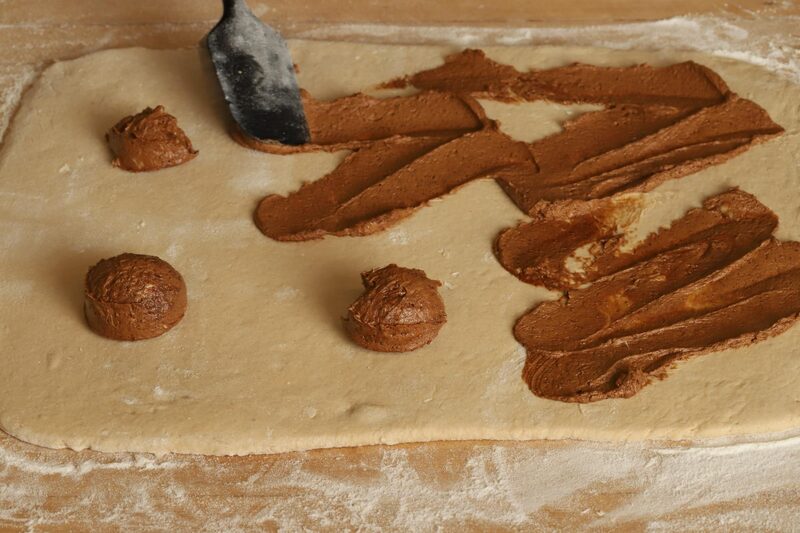
- Spread it on. To apply the filling, place a few spoonfuls spaced out around the center of your dough and spread outward. Work from the inside out to avoid reshaping your rectangle. Make sure filling reaches all the way to the edges.
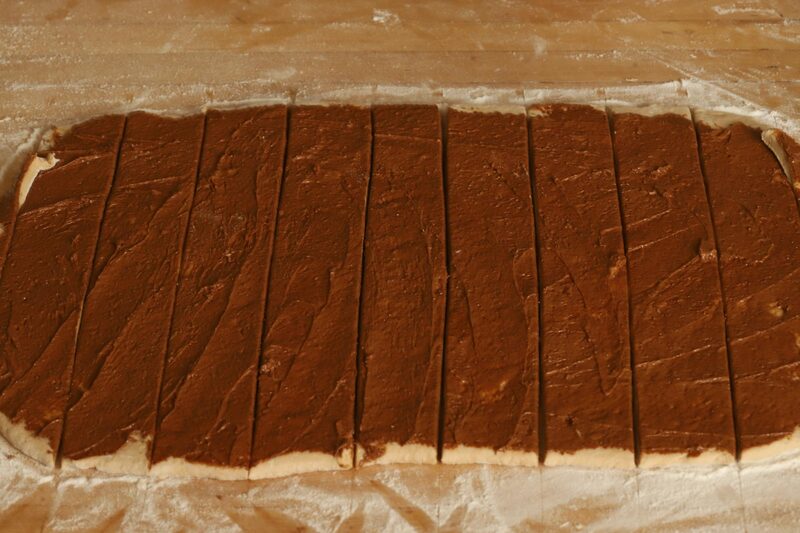
- Shape your rolls. For the best presentation, slice your 2-inch rolls first before rolling them up individually. Roll each one with some give — do not roll too tight or the rolls will break open during proofing. Grease your pan well. Place each roll with the seam facing inward, pressing against the neighbouring roll or the wall of the pan. This prevents unravelling as they expand.
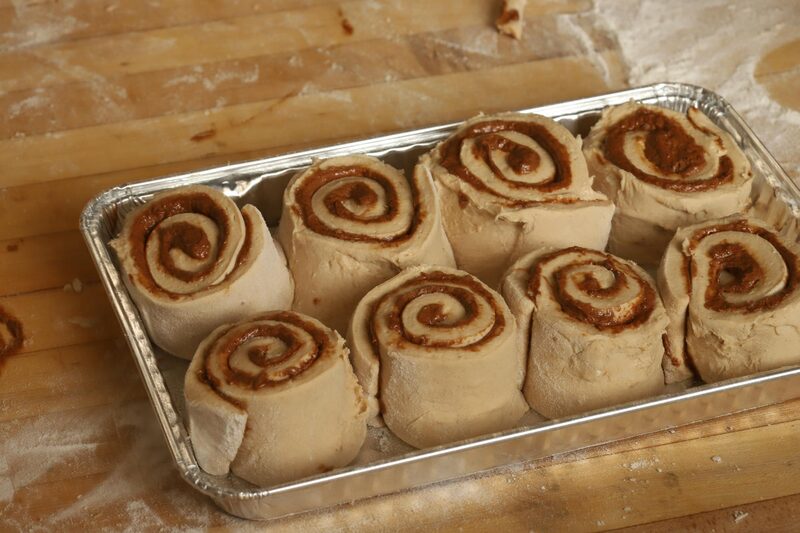
- Proof. Cover loosely with a cloth or plastic wrap — not airtight. Let rise at room temperature.
Hybrid method: approximately 3 hours.
Full yeast version: approximately 1.5 hours.
Full sourdough version: minimum 6 hours at room temperature. - Bake. Preheat your oven to 350°F for at least 20 minutes before baking. Remove the cover from your rolls. Pour your favourite alternative milk over and around the rolls, filling to about a quarter to half an inch — this keeps them gooey and delicious. Place in the oven and bake for 20 min, until golden.
- Let cool. This is non-negotiable with gluten-free baked goods. If you eat them warm they will taste gummy and underdone even when fully baked. Let cool for at least 35 minutes before frosting. For best results, chill in the refrigerator, then reheat individual rolls before serving.
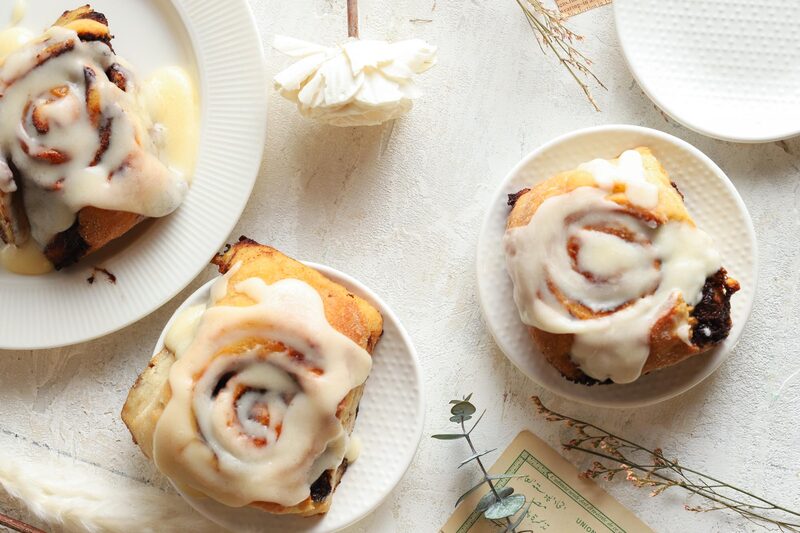
- Make the frosting. Beat vegan butter and cream cheese together first until smooth. Add powdered sugar gradually while mixing. Add water, vanilla powder, cornstarch, and a pinch of salt. Beat until creamy and spreadable. Makes enough for 12 rolls. Spread generously over completely cooled cinnamon rolls.
Make Ahead & Freezing
The most common question I get on this one is from smaller households: twelve rolls is a lot — can you freeze them? Yes, and freezing before the proof is the way to do it.
Freeze the shaped rolls, unproofed. Take them through step 9 — shaped and cut — then skip the proof and the milk. Line them up on a tray so they aren’t touching, freeze until solid, then bag them. They keep about a month. Freezing raw, before the rise, is what lets you bake two at a time instead of all twelve.
To bake from frozen: set as many as you want in a greased pan, cover loosely, and let them thaw and proof at room temperature until risen and puffy. Cold dough proofs slowly, so give it longer than a fresh batch — a few hours for the yeast and hybrid versions. Then pour the milk around them and bake per step 11.
You can also freeze them fully baked and unfrosted: cool completely, freeze, then reheat and frost fresh the day you want them. But raw-and-shaped is the one I’d pick — it comes out closest to a fresh batch.
Want the rolls without the wait?
Get the treat minus the effort fresh from our bakery.
Shop at Sensible →